
The Origin of Shah Abbas Motifs in Persian Carpets: History, Art & Cultural Significance
Persian carpets are world-renowned for their intricate floral patterns and flowing vine designs. Among the most iconic motifs is the Shah Abbas pattern, a signature element that reflects not only exceptional craftsmanship but also a rich historical legacy.
But what exactly is the origin of this pattern, and why does it hold such importance in the world of luxury carpets?
1. Who Was Shah Abbas?
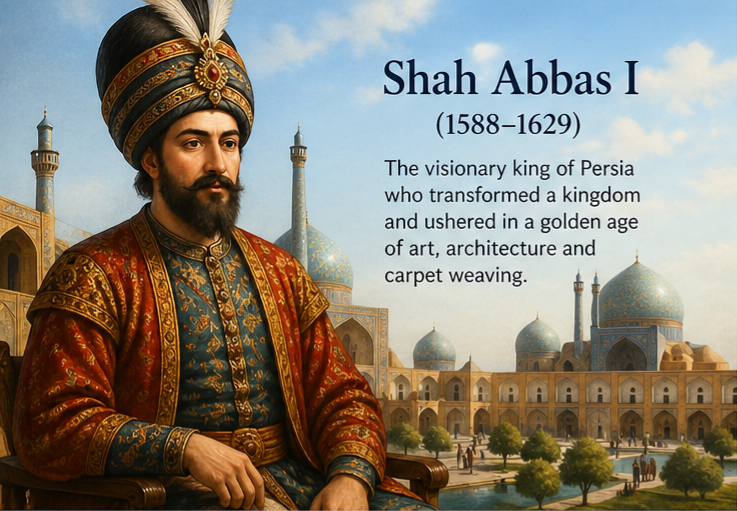
The Shah Abbas motif is named after Shah Abbas I (1588–1629), one of the most powerful rulers of the Safavid Empire (modern-day Iran). Often referred to as the “Carpet King,” Shah Abbas played a crucial role in transforming Persian carpet weaving into a global symbol of luxury and artistry.
During his reign, Persia experienced:
- Political stability after expelling Ottoman and Uzbek forces
- Strong economic growth through international trade
- A cultural golden age supported by royal patronage
His leadership laid the foundation for the global reputation of Persian carpets.
2. The Golden Age of Persian Carpet Weaving
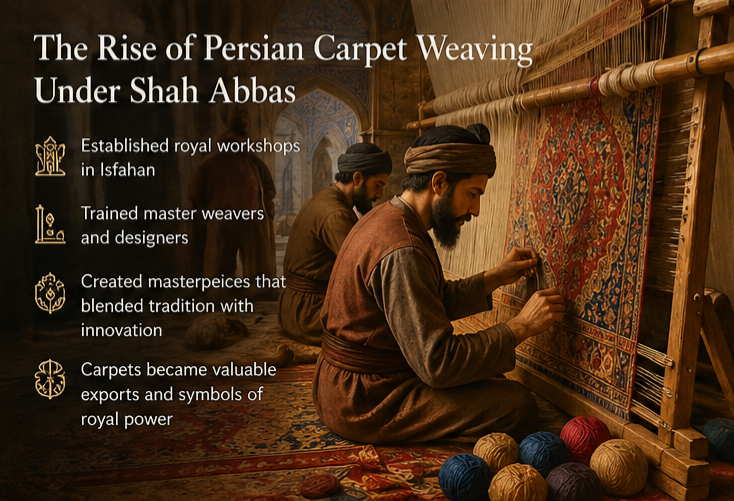
Shah Abbas moved the capital to Isfahan, which quickly became the center of carpet production. He established royal weaving workshops and training schools, bringing together skilled artisans from across the empire.
Key developments during this period included:
- Collaboration between artists and weavers, elevating carpet design to fine art
- Introduction of new color combinations and complex patterns
- Expansion of carpet exports to Europe, boosting global demand
Persian carpets were no longer just functional items—they became symbols of wealth, power, and artistic excellence.
3. What Is the Shah Abbas Motif?
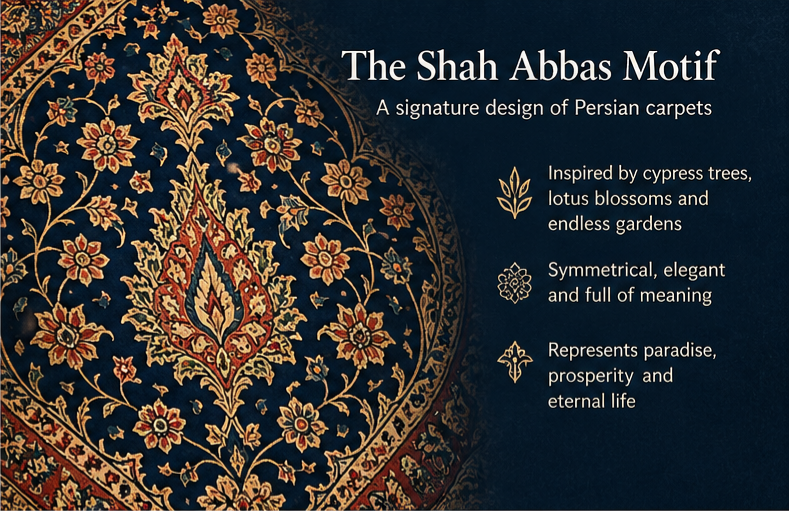
The Shah Abbas motif is a stylized floral design, often resembling a palm leaf, lotus, or palmette, combined with elegant vine scrolls.
Key Characteristics:
- Symmetrical floral compositions
- Flowing vine structures connecting elements
- Rich layering with multiple leaves and petals
- Balanced yet highly detailed design
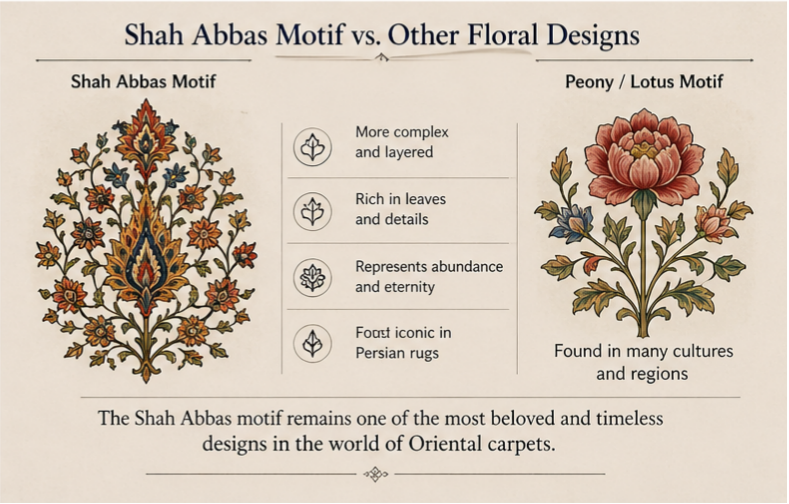
Compared to simpler floral patterns like peony or lotus, the Shah Abbas motif is more complex, refined, and visually dynamic.
4. Cultural and Artistic Significance
The Shah Abbas pattern is more than decoration—it represents:
- Royal power and prestige of the Safavid dynasty
- The fusion of Persian tradition and external artistic influences
- The peak of Islamic decorative art in textiles
Under Shah Abbas, Persia embraced cultural diversity. His policies encouraged trade and interaction with Europe, influencing carpet design and expanding artistic expression.
5. Why This Pattern Became So Popular
Several factors contributed to the global popularity of Shah Abbas designs:
- Royal endorsement: Produced in court workshops
- High craftsmanship standards: Created by master artisans
- Export expansion: Widely traded across Europe and Asia
- Timeless aesthetic: Balanced elegance and complexity
Today, this motif remains a defining feature of traditional Persian carpets.
6. Influence Beyond Persia
Although the Shah Abbas motif originated in Persia, its influence has spread worldwide. You can now find variations of this design in:
- Indian handmade carpets
- Pakistani traditional rugs
- Chinese antique-style carpets
Despite these adaptations, the design remains closely associated with the Safavid era and Persian cultural identity.
7. Shah Abbas Motif vs Other Floral Designs
Compared to simpler floral motifs:
- Peony or lotus patterns: More minimal and symbolic
- Shah Abbas motifs: Richer layers, more intricate details, and stronger visual depth
This complexity is one of the reasons why carpets featuring Shah Abbas designs are often considered high-end products.
8. Why It Matters for Buyers
For importers, designers, and project buyers, understanding the Shah Abbas motif helps in:
- Identifying authentic Persian-style carpets
- Selecting products with higher artistic and cultural value
- Differentiating premium carpets in competitive markets
Carpets with this pattern are ideal for:
- Luxury hotels and resorts
- High-end residential interiors
- Cultural or heritage-themed projects
Conclusion
The Shah Abbas motif is not just a decorative element—it is a symbol of a golden era in Persian history, where art, culture, and craftsmanship reached extraordinary heights.
From royal workshops in Isfahan to modern global markets, this timeless design continues to represent luxury, heritage, and artistic excellence.
For buyers seeking carpets that combine history, beauty, and value, Shah Abbas designs remain one of the most iconic and desirable choices in the world of handmade carpets.