
Simplified Handmade Carpet Production Process
How Engineering & Handmade Carpets Are Crafted Step by Step
Handmade carpets are often seen as luxury art pieces, but behind every high-quality engineering carpet or handmade project carpet lies a rigorous, professional production process.
This article provides a clear, simplified overview of how handmade carpets are produced—from raw materials to the finished product—helping project buyers better understand quality differences and craftsmanship value.
As an experienced carpet manufacturer serving commercial and engineering projects, Liaoning Taiyi Carpet Co., Ltd. shares this process to help clients make informed decisions.
1. Raw Material Preparation
The foundation of a high-quality carpet is its raw material.
- Wool:
Historically, carpets used local wool such as Ningxia wool, Qinghai wool, Tibetan wool, or Hetian wool.
Today, for engineering and commercial carpets, imported New Zealand wool is preferred for its:- High elasticity
- Uniform fiber thickness
- Superior durability
- Silk:
High-end handmade carpets use mulberry silk, offering smooth texture, natural luster, and refined detail.
2. Artistic Design & Pattern Creation
Carpet design is a critical value-adding stage.
✔ Designers create the carpet pattern
✔ Designs are translated into weaving blueprints
✔ These blueprints guide weavers throughout the entire process
A strong design significantly enhances both the visual impact and commercial value of engineering carpets used in hotels, offices, and public buildings.
3. Yarn Dyeing & Ply Twisting
Based on the design:
- Yarn is dyed into matching colors
- One carpet may require dozens of color tones
- Dyed yarns are twisted into 3-ply, 4-ply, or 6-ply strands
- Yarn is wound into balls for weaving
Color accuracy is especially important for custom engineering carpet projects.

4. Tool Preparation: The Right Tools Matter
Professional handmade carpet tools include:
- Beaters (for compacting weft threads)
- Knives (for cutting yarn during knotting)
- Scissors (for trimming pile height and surface finishing)
These tools directly influence carpet density, durability, and surface quality.
5. Loom Assembly
The loom (weaving frame) is built according to carpet size.
Different project specifications require different loom dimensions, especially for large-format engineering carpets.
6. Warping the Loom (Setting Warp Threads)
Warping involves:
- Fixing warp threads to the loom based on carpet size
- Installing heddle rods
- Usually completed by three skilled workers
This step ensures correct structure and dimensional stability.
7. Hand Knotting – The Core of Handmade Carpets
The Most Critical Step
Hand knotting is what fundamentally differentiates handmade carpets from machine-made carpets.
- The most common technique is the figure-eight (Persian) knot
- Yarn is tied around two warp threads
- Each knot forms a pile head on the surface
Process flow:
- Knot one row
- Insert a weft thread
- Compact with a beater
- Repeat row by row
A full carpet is created entirely through this repeated process.
Knotting Techniques & Artistic Control
Besides figure-eight knots, other techniques include:
- Horseshoe knots
- Chain knots
- Plum blossom knots
- Combination knots
These techniques are applied flexibly based on pattern requirements to achieve maximum artistic expression.
Experienced weavers also perform manual color blending during knotting—especially for gradient areas and animal hair patterns—something machine carpets cannot replicate.
Even with the same design, different weavers produce different visual depth and texture.
This human craftsmanship is what gives handmade engineering carpets their unique value.
8. Carpet Leveling (Pile Shearing)
After knotting, the carpet surface is leveled:
- Excess pile height is trimmed
- Thickness is standardized
- Silk carpets are usually thinner than wool carpets
This step ensures a smooth, even surface, essential for commercial and engineering applications.
9. Sculpting & Carving (Chinese-Origin Technique)
Some carpets undergo hand carving, a technique invented in China around 1930.
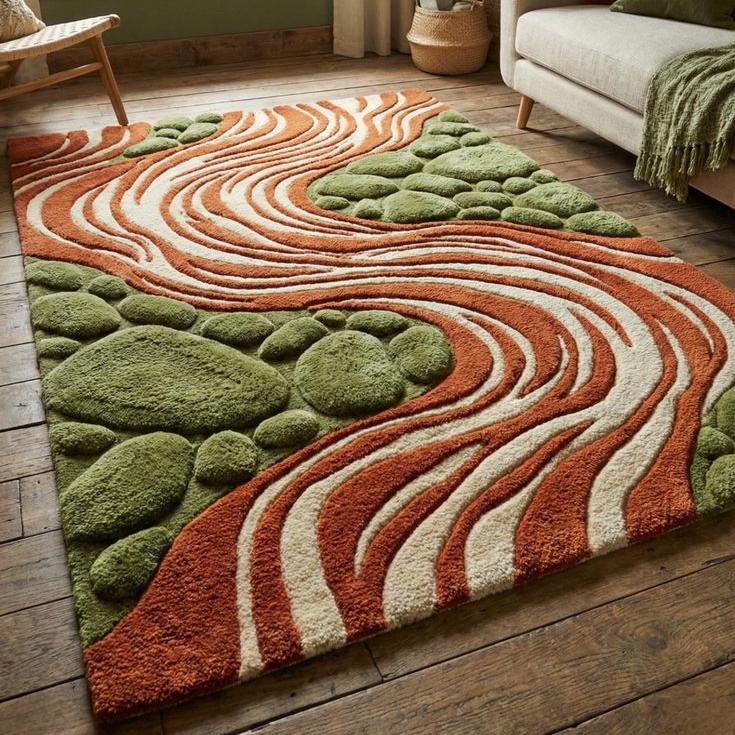
✔ Creates relief-like, three-dimensional effects
✔ Enhances pattern clarity
✔ Corrects minor weaving imperfections
Not all carpets require carving—wool carpets use this technique more frequently than silk carpets.

10. Back Finishing (Flame Treatment)
Loose yarn ends on the carpet back are removed using controlled flame treatment.
- Silk is naturally flame-retardant
- Wool has a high ignition point
This method efficiently creates a clean, flat backing.
11. Carpet Washing & Drying
The carpet is thoroughly washed through:
- Soaking
- Brushing
- Rinsing
- Dehydration
- Drying
This process removes grease, dust, and impurities, ensuring cleanliness and color stability.
12. Fringe Finishing & Final Inspection
Final steps include:
- Braiding and finishing fringes
- Detailed surface inspection
- Minor corrections and refinements
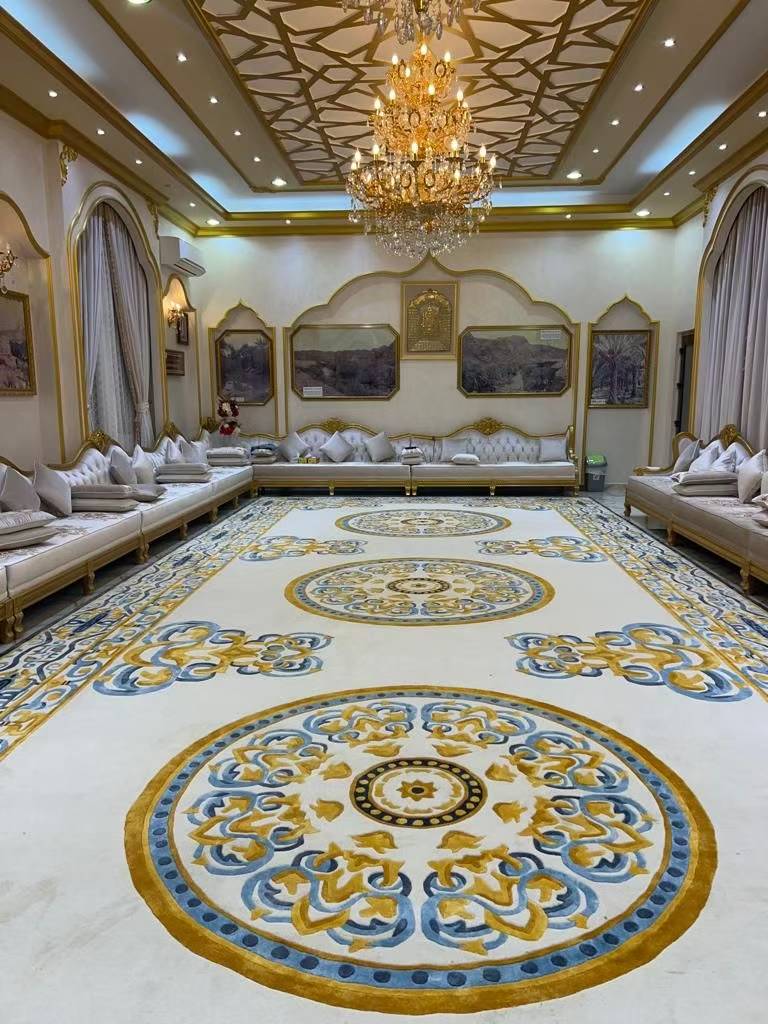
At this point, a complete high-quality handmade engineering carpet is finished.
Why This Process Matters for Engineering Carpet Projects
Understanding the handmade carpet process helps buyers:
✔ Identify true handmade quality
✔ Avoid machine-made imitations
✔ Justify long-term project value
✔ Select the right supplier with confidence
Engineering Carpet Solutions by Liaoning Taiyi Carpet
Liaoning Taiyi Carpet Co., Ltd. provides handmade and engineering carpet solutions for:
- Hotels & resorts
- Office buildings
- Public venues
- Luxury commercial spaces
Our Advantages:
✔ Professional engineering carpet manufacturer
✔ Wool & silk handmade carpets
✔ Custom sizes, patterns & specifications
✔ Stable quality for large-scale projects
✔ Factory-direct supply from China
Looking for a Reliable Engineering Carpet Partner?
If you are planning a commercial or engineering carpet project, contact Liaoning Taiyi Carpet for expert guidance, samples, and tailored solutions.
True craftsmanship. Engineered for lasting value.